

White stuff in kombucha is often completely normal. In many cases, it’s yeast, new pellicle growth, or harmless sediment. But if the white growth is dry, fuzzy, or growing above the liquid line, it’s likely mold and the batch should be discarded.
The key is knowing the difference. This guide will show you exactly what white stuff in kombucha means, how to identify normal fermentation vs contamination, and when it’s safe to keep brewing.
The Fast Diagnostic: What Does It Look Like?
Start here. Find what matches what you’re seeing, then read the detailed section below if you need more context.
| If it looks like… | It’s probably… | Action |
|---|---|---|
| Smooth, wet, white or cream film floating on top | New pellicle forming | Keep brewing ✓ |
| Cloudy white strings or strands hanging in the liquid | Yeast strands | Totally normal ✓ |
| White blobs floating in the liquid | Yeast colonies or baby SCOBY | Normal ✓ |
| White sediment collecting at the bottom | Yeast fallout | Normal ✓ |
| Dry, fuzzy, circular white patches on the SCOBY or vessel wall | Mold | Discard ✗ |
| Powdery or chalky white growth above the liquid line | Mold | Discard ✗ |
| White film with any pink, black, green, or orange tint | Mold or contamination | Discard ✗ |
What’s Normal: The White Stuff You Don’t Need to Worry About
A Thin White Film on Top
One of the most common panic triggers for new brewers: you wake up to find a thin, whitish layer sitting on the surface of your kombucha. It looks vaguely like a skin. That’s almost certainly the start of a new pellicle — the SCOBY forming its next layer. Young pellicles often look patchy, uneven, translucent, or off-white before they thicken and become more opaque. They can also look bubbled, puckered, or wrinkled.
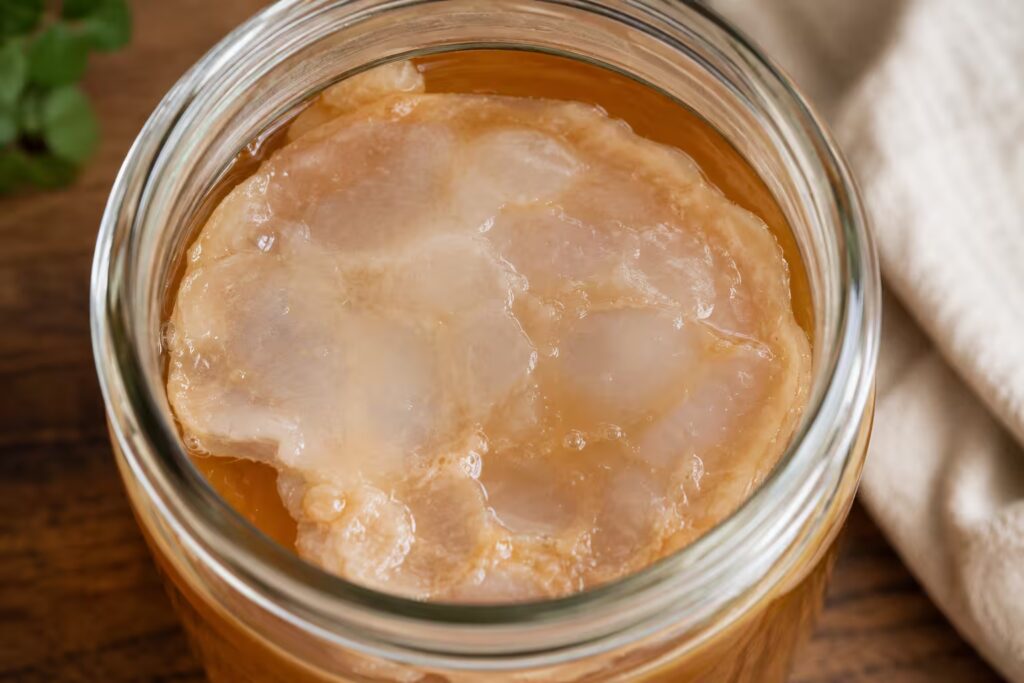
The key characteristic: visually, it sits flush with the liquid surface and moves with it when you tilt the vessel. Normal pellicle formation follows the liquid surface. It looks like a gel or rubber membrane, not like powder or fuzz.
New pellicles can also form unevenly covering only part of the surface, appearing in patches, or looking brownish or tan in areas where SCOBY material or tea residue has settled into it. All of this is normal.
 Old School Tip: New pellicles are often patchy, wrinkled, or unevenly colored, especially in the first few days. Irregular appearance alone is not a red flag.
White Cloudy Strings or Strands
Wispy, stringy, or thread-like white material hanging down from your SCOBY into the liquid is yeast, specifically, the long-chain yeast strands that are a natural byproduct of fermentation.
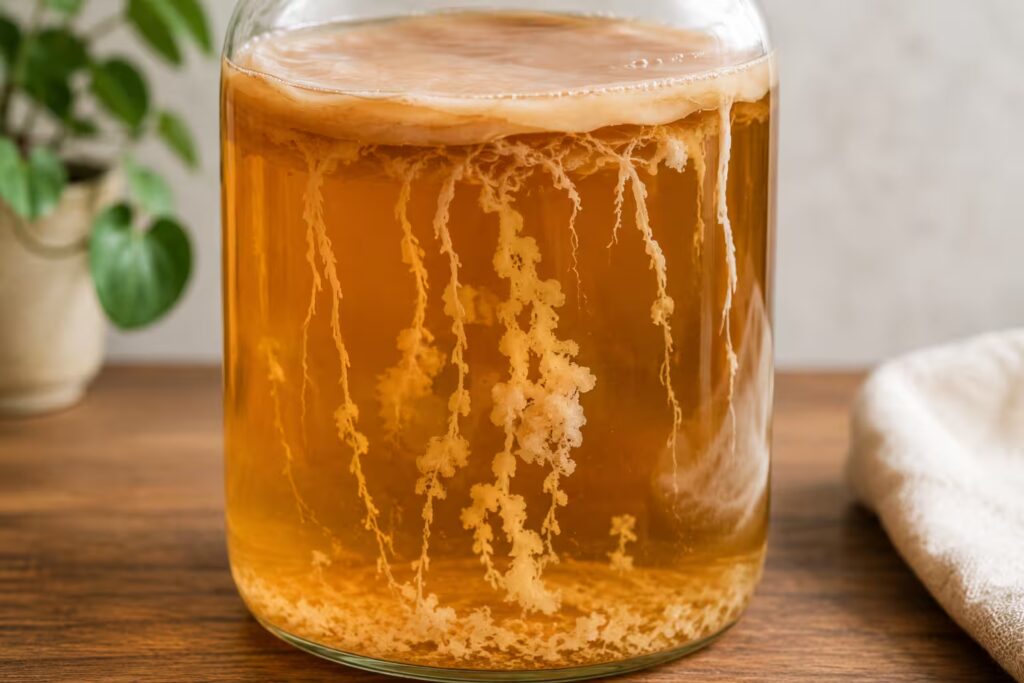
These strands can look alarming if you’re not expecting them. Some batches have very little visible yeast; others have significant cloudy masses of it, depending on your brew temperature, tea strength, and how active your culture is. Both are normal.
The liquid itself may look slightly murky or hazy, especially toward the end of fermentation. This is yeast activity, not contamination.
Floating White Blobs
White blobs that float through or sit in your kombucha are typically concentrated yeast colonies or loose pellicle material. Pellicle fragments and yeast masses can form strange floating blobs in active kombucha.
The defining feature: these blobs sit in the liquid, move freely when the vessel is tilted, and have no dry or fuzzy surface texture. They are not raised, powdery, or sitting above the liquid line.
White Sediment at the Bottom
White or beige sediment collecting at the bottom of your jar is normal yeast fallout. As yeast cells become inactive or die, they sink. This sediment can also include tea particles or SCOBY fragments that have broken off.
Old School Tip: White sediment is harmless. Pour it off during bottling if the appearance bothers you.
What Is Kahm Yeast?
Kahm yeast occasionally shows up in kombucha and gets mistaken for either pellicle or mold. It’s a harmless wild yeast that forms a thin, flat, matte-white film on the surface; Flatter and more papery than a proper pellicle, with irregular or wavy edges. It won’t make you sick, but it can impart off-flavors. If you’re confident it’s kahm yeast rather than mold, it can usually be skimmed off, though many brewers choose to restart for flavor quality.
What’s Not Normal: When White Means Mold
Here’s where the guide gets more serious, because mold in kombucha is a real risk; Rare, but real and it should always be taken seriously.
 Take Heed: If you identify mold in your kombucha, discard the entire batch, including the SCOBY and the starter liquid. Mold contamination penetrates deeper than the visible surface, and your starter liquid can harbor mold spores that will contaminate your next batch.
What Kombucha Mold Actually Looks Like
Mold on kombucha has two telltale characteristics that distinguish it from normal fermentation activity:
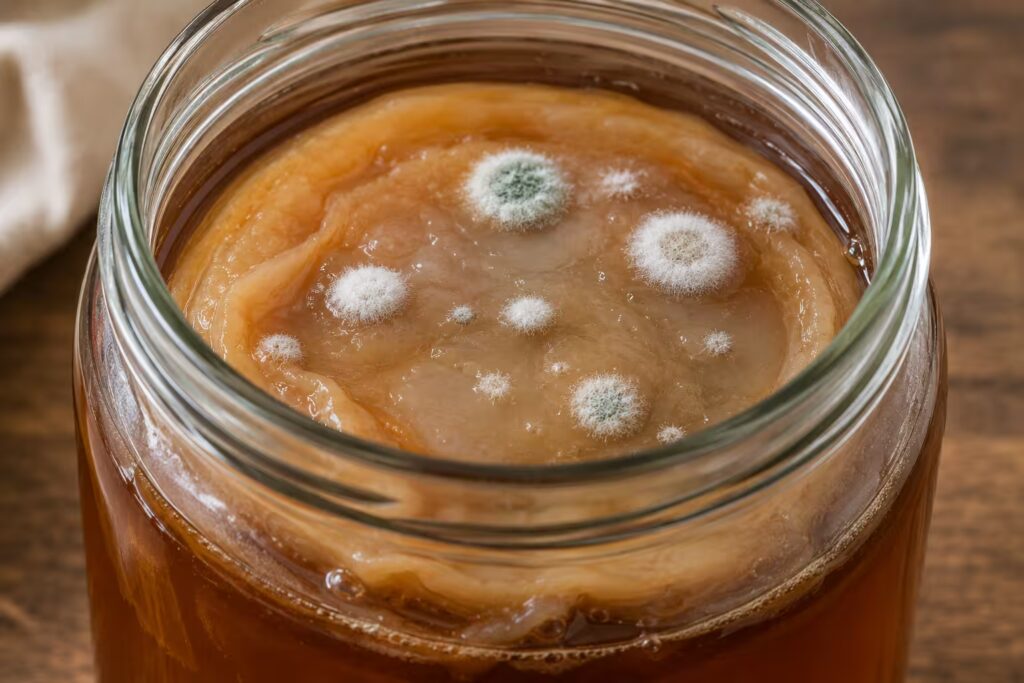
- It is dry and fuzzy. This is the most important diagnostic. Normal kombucha growth — pellicle, yeast, sediment — is always wet. It’s in a liquid environment and it behaves like it. Mold is dry. It has a powdery, fuzzy, or furry texture. If you tilt your vessel and the white material doesn’t move with the liquid, that’s a warning sign.
- It grows in discrete, circular, or patchy spots. Mold colonies tend to form in distinct circles or irregular fuzzy patches rather than spreading as a uniform film. They often appear raised above the liquid surface.
- It may grow on the vessel walls above the liquid line. If you see white fuzzy growth on the glass or ceramic above where your liquid sits, that’s mold — not pellicle, which only forms at the liquid surface.
- It may have color. While white mold exists, mold contamination in kombucha often shows green, black, blue, pink, or orange alongside the white — especially as it matures. Any non-white mold is an unambiguous discard.
Why Does Mold Grow?
Kombucha’s natural acidity makes it hostile to most mold, but that protection isn’t instant. It builds over the first few days of fermentation, which is exactly when contamination risk is highest. Mold tends to occur when:
- The brew wasn’t acidic enough to start. Using too little starter liquid (the finished kombucha you add at the beginning of each batch) means your brew starts at a higher pH and is more vulnerable during the early, critical days of fermentation.
- Contaminated equipment. Mold spores on your jar, cloth cover, brewing equipment, or even your hands can inoculate a batch.
- Warm, stagnant air above the brew. Poor airflow combined with warmth and residual sugar creates the conditions mold loves.
- The cloth cover isn’t breathable or is too loose. Your cover needs to allow CO₂ out while keeping contaminants in. A loosely draped paper towel, a thin cloth, or a cover that moisture can collect on creates risk.
Old School Tip: The single most effective mold-prevention step is using enough starter liquid. A ratio of at least 1 part starter to 10 parts sweet tea is a reliable baseline. If you’ve had a mold problem, increase that ratio for your next batch.
Common Beginner Misidentification Mistakes
Mistaking a Young Pellicle for Mold
New pellicles often form unevenly, with patches, gaps, bubbles, and discoloration. They may look nothing like the smooth, uniform, beige disc you’re expecting. First-time brewers frequently mistake a patchy, bubbly, or irregular new pellicle for contamination.
Remember: if it’s wet, smooth, and follows the liquid surface, it’s pellicle. Even ugly pellicle is still pellicle.
Mistaking Yeast Strands for Something Sinister
Long, wispy, brown-to-white strands drifting through your brew look strange if you’ve never seen them before. They’re just yeast. They’re one of the most normal things in a kombucha jar.
Thinking Bubbles Are White Stuff
CO₂ bubbles collecting under or on top of the SCOBY can look like a white foam or cluster of white dots. If it disperses when you tilt the vessel or tap the jar, it’s just gas.
Assuming Acidic Kombucha is Always Safe
This is a more subtle mistake, but worth addressing: because kombucha is acidic, some brewers assume that if it “smells like kombucha,” it can’t be moldy. This isn’t reliable. Mold can grow in the early days of fermentation before acidity is fully developed, and early-stage mold doesn’t always have a noticeable smell. Trust your eyes over your nose.
When to Discard Kombucha
Be firm with yourself here. Discard if:
- You see dry, fuzzy, or powdery white spots anywhere on the SCOBY or vessel
- You see any mold growth above the liquid line on the vessel walls
- You see any mold in colors other than white (green, black, pink, orange)
- Your kombucha has an unpleasant smell that isn’t the normal sour/vinegary tang (rotten, putrid, or chemical smells)
- You cannot confidently distinguish normal fermentation from mold
The batch and SCOBY aren’t worth the risk. Starter culture is easy to get again.
Troubleshooting: Other White Stuff Scenarios
The White Film Has a Slight Brown or Tan Tinge
Very common. Pellicles form in contact with tea, so they absorb color from the brew. A slightly brown, tan, or tea-colored SCOBY or pellicle is normal and expected.
There’s White Stuff Only on Part of the SCOBY Surface
Partial pellicle formation is normal, especially in the early days of a new batch or when you’ve started with a thin or irregular SCOBY. Give it time.
FAQ
Can I drink kombucha with white stuff in it?
It depends on what the white stuff is. If it’s a pellicle, yeast strands, or sediment — yes, it’s safe to drink. If it’s mold. Dry, fuzzy, raised patches, especially with any color, do not drink it. Discard the entire batch. When in doubt, use the diagnostic table at the top of this article.
Is white stuff on top of kombucha always mold?
No. The most common cause of white material on top of kombucha is a new pellicle forming — a normal, healthy part of fermentation. Mold is dry and fuzzy; normal pellicle is wet and smooth.
What does kombucha mold look like?
Kombucha mold typically appears as dry, fuzzy, circular patches. It may be white, green, black, or a combination. It often grows in discrete spots rather than as a uniform film, and it can appear above the liquid line.
Can I scrape mold off my SCOBY and keep brewing?
No. If you find mold, discard the entire batch including the SCOBY and starter liquid. Mold penetrates below the surface and can contaminate your next batch even if you can’t see it.
What are the white strings in my kombucha?
White or brown stringy material hanging in your kombucha is yeast — completely normal. It’s a natural byproduct of fermentation and doesn’t affect safety or flavor significantly.
Why does my kombucha look cloudy and white?
Cloudiness is typically caused by yeast activity, especially toward the end of fermentation or when you disturb the brew. It’s normal. Mold does not make liquid cloudy. Mold grows as surface or wall growth, not dissolved cloudiness.
What is kahm yeast in kombucha?
Kahm yeast is a type of wild yeast that forms a thin, flat, matte film on fermented liquids. It’s harmless but can affect flavor. It looks flatter and more papery than a proper pellicle, with irregular or wavy edges.
How do I prevent mold in kombucha?
Use sufficient starter liquid (acidified finished kombucha), keep your equipment clean, ensure your cover allows airflow while blocking contaminants, and ferment within the optimal temperature range. Adequate starter acidity is the single most important mold-prevention factor.